How to Design a Controlled Compost Additive Trial Without Fooling Yourself
A compost additive trial can look successful for the wrong reasons.
A warmer week. A cleaner batch of incoming feedstock. A more attentive operator. A windrow that was turned at the right moment. Any of these can make an additive appear stronger than it is — or hide a useful improvement your site could have captured.
LoamForge supplies enzyme solutions for organic waste processing, but we do not recommend judging any compost treatment by a single impressive pile. Facility buyers need a trial structure that separates real process value from daily noise.
If you are evaluating a compost enzyme supplier for organic waste processing, the goal is not to create a perfect demonstration pile. The goal is to determine whether the additive improves your operation under conditions your team actually faces.
The trial should answer an operational question
Before you order product, decide what decision the trial is supposed to support.
Good trial questions sound like this:
- Can we reach and hold process heat more consistently across variable food waste and yard waste blends?
- Can we reduce odor pressure during early active composting without slowing breakdown?
- Can we improve pile response when feedstock arrives wetter, denser, or less uniform than planned?
- Can we shorten the active phase enough to free pad space or improve turner scheduling?
- Can we produce a more consistent finished compost profile with fewer rework issues?
Weak trial questions sound like this:
- Does the treated pile look better?
- Did it smell less on one inspection day?
- Did it get hot faster once?
- Did the operator like it?
Composting is too variable for casual conclusions. A useful trial is built around the facility outcomes that affect cost, throughput, compliance pressure, and customer acceptance.
Start with a baseline, not a sales pitch
A controlled trial begins before the additive is applied.
Pull recent operating records for comparable windrows, bays, or static piles. Look for the normal range of:
- Time to stable process heat
- Peak and average internal temperatures by zone
- Temperature drop-off after turning
- Moisture correction events
- Odor complaints or internal odor observations
- Turning frequency and equipment time
- Pad residence time
- Screening rejects or oversize trends
- Finished compost consistency issues
This baseline tells you what the site already does. Without it, the trial becomes a story instead of a decision tool.
If records are incomplete, do not delay forever. Build a short pre-trial observation window and document the current process with the same measurements you will use during the trial.
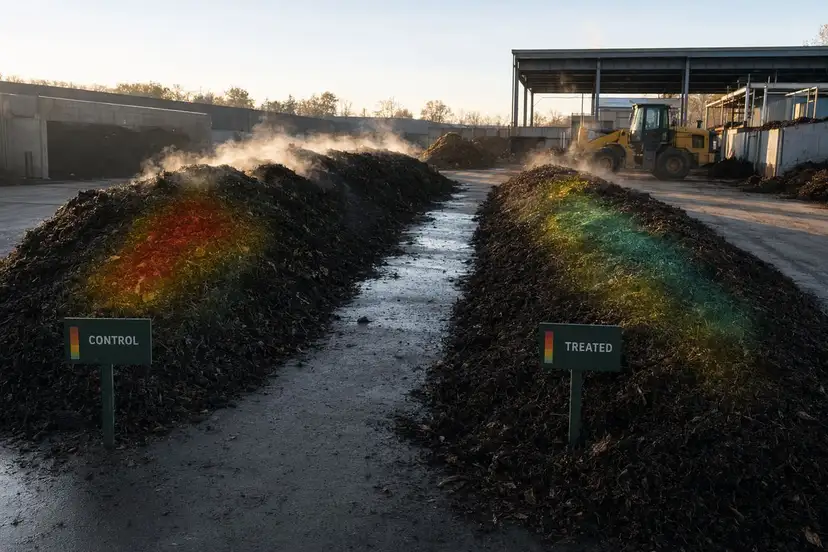
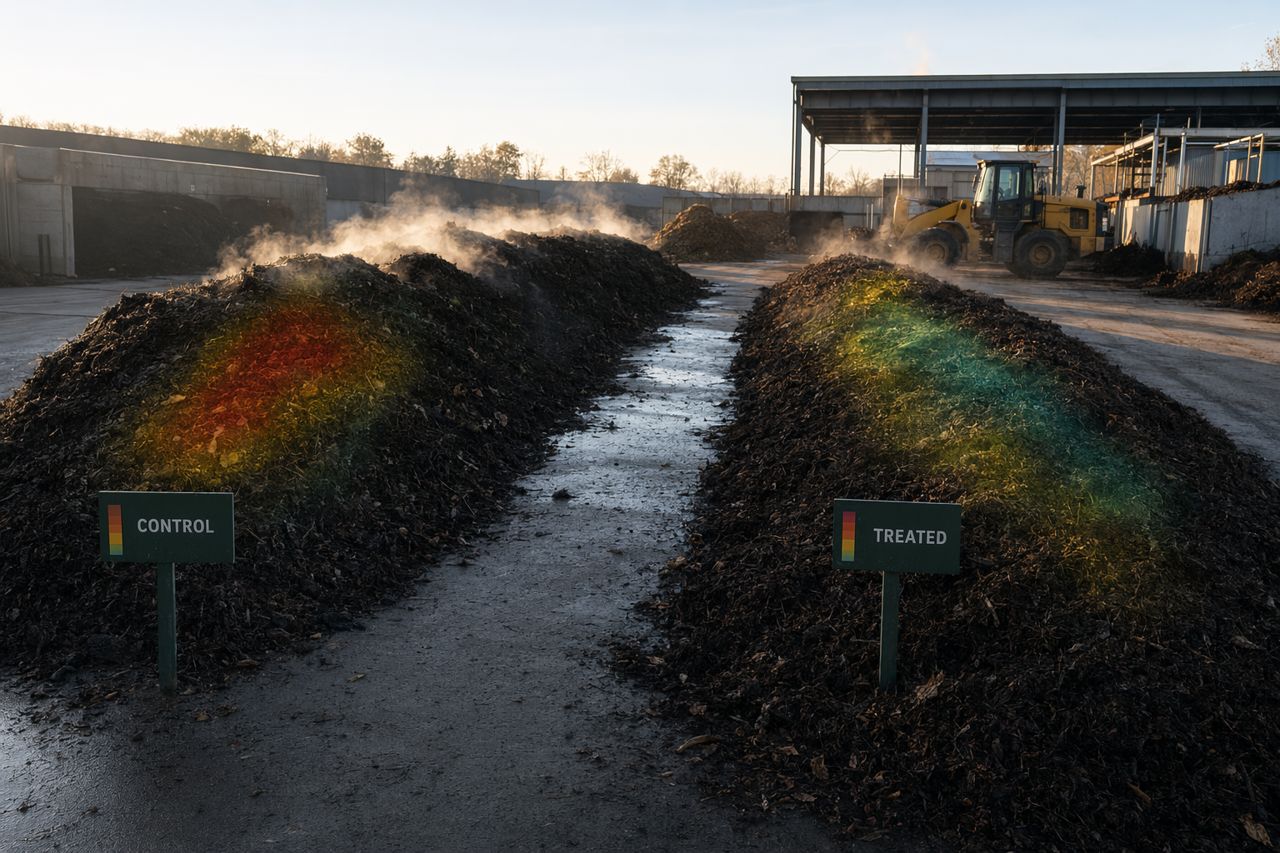
Use a treated pile and a matched control
The fastest way to fool yourself is to treat one pile and compare it to memory.
Run a treated pile beside an untreated control whenever possible. Match them as closely as the site allows:
- Same feedstock mix window
- Similar pile size and shape
- Similar starting moisture target
- Same pad area or similar exposure conditions
- Same turning schedule
- Same operator instructions
- Same monitoring frequency
No compost facility can make two piles identical. That is fine. The point is to reduce the biggest sources of distortion.
If you cannot run side-by-side piles, use a sequential trial with strong documentation. Treat a pile after you have recorded an untreated pile under comparable feedstock and weather conditions. This is less powerful than a matched control, but it is still better than a one-off demonstration.
Do not let feedstock variability bury the signal
Organic waste processing is not a clean-room operation. Your incoming material changes by route, season, generator behavior, weather, and contamination level.
A compost enzyme trial should either control feedstock variability or intentionally test against it.
Option 1: Controlled feedstock window
Use a narrow intake window where the feedstock blend is reasonably predictable. This is useful when you want a clean answer on heat curve, odor pressure, and breakdown behavior.
Option 2: Stress-condition trial
Choose a feedstock condition that regularly creates problems, such as wet food waste, dense green waste, or high paper/organics blends. This is useful when the business case depends on improving difficult material.
Do not mix these two strategies without saying so. A trial designed to prove performance under stable conditions should not be judged against crisis-feedstock expectations. A stress trial should be judged by how well the additive helps the site regain control.
Define what success means before the first application
Success criteria should be written down before the trial starts.
Examples of useful success metrics include:
- More even heat distribution across pile zones
- Faster return to target heat after turning
- Fewer cold pockets requiring corrective action
- Reduced odor intensity during the early active phase
- Less need for emergency moisture or structure correction
- More predictable active-phase duration
- Improved screening behavior or reduced rework
- More consistent finished compost appearance and handling
Avoid vague labels like “better decomposition.” If the team cannot measure or observe it consistently, it should not decide the purchase.
Keep application practical
A good compost additive trial must fit the way the facility works.
If application requires unrealistic labor, equipment changes, or process interruptions, the results may not translate to full-scale use. The application plan should be compatible with existing receiving, blending, turning, or pile-building steps.
Before the trial, decide:
- Where the additive enters the process
- Who applies it
- How the product is staged and handled
- How application is confirmed
- What happens if a pile is delayed, reworked, or re-formed
- How operators record deviations
LoamForge supports trial planning around site workflow because a product that only works under special handling conditions is not a facility solution.
Keep operators aligned, but do not over-coach the result
Operators can make or break a trial. They know the material, the equipment, and the warning signs.
Bring them into the plan early. Explain what is being compared, what should be recorded, and what should not be changed unless required for safety or compliance.
At the same time, avoid giving the treated pile special attention. If the treated pile gets better turning, better moisture correction, and more supervision, the trial is no longer testing the additive. It is testing extra care.
The rule is simple: manage both treated and control piles according to the same operating standard.
Monitor the process where decisions are made
Data should be collected in a way that reflects actual facility control.
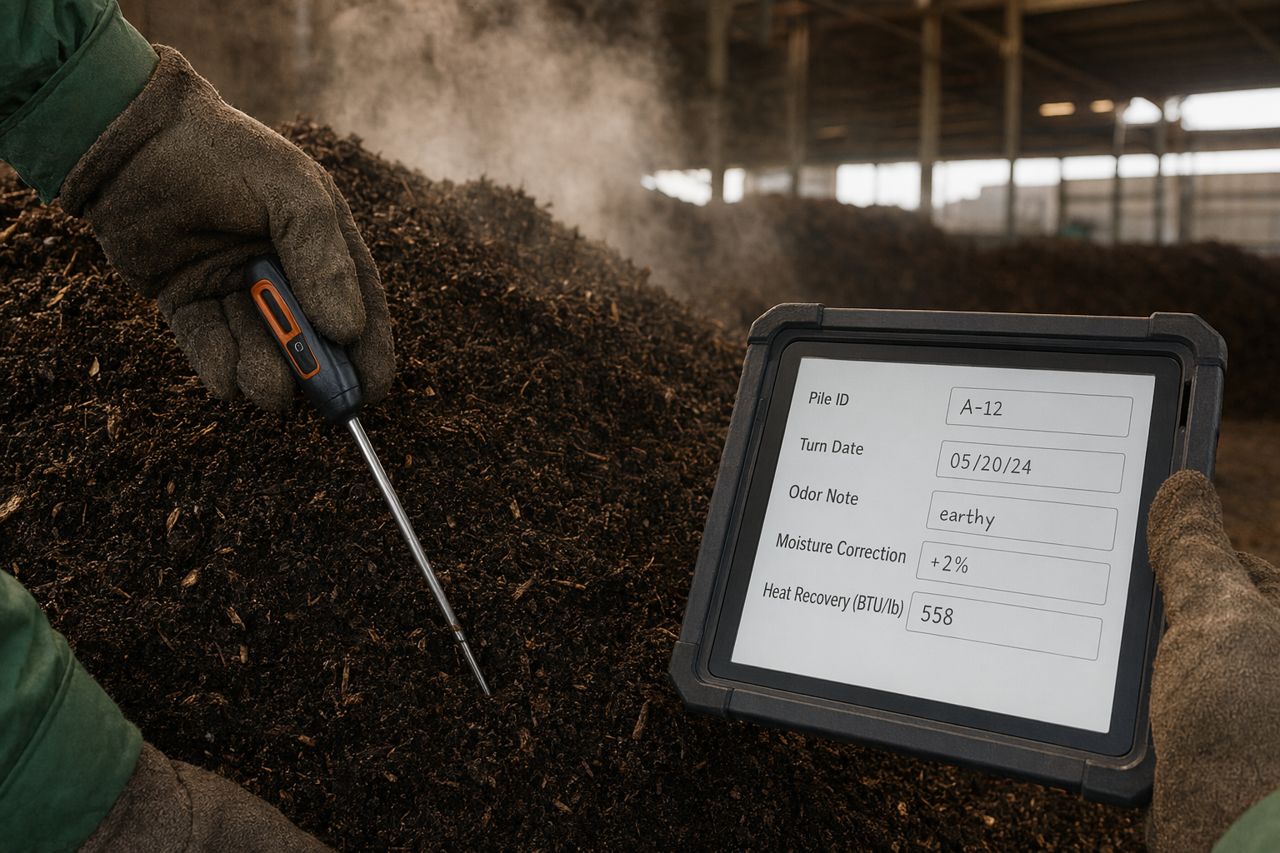
Useful monitoring points include:
- Core and shoulder temperature trends
- Heat recovery after turning
- Visual structure and matting
- Moisture feel and correction events
- Odor observations at consistent times and locations
- Leachate or wet pocket indicators where relevant
- Equipment time and turning notes
- Screening and curing observations
Use the same tools and routines across treated and control piles. If your team uses probe readings, route checks, and operator logs to manage the site, the trial should strengthen those records — not replace them with lab-only information.
Watch the heat curve, not just the peak
Peak heat can be misleading.
A pile that spikes hot and then drops unevenly may not be under better control. For compost facilities, the stronger signal is the shape of the heat curve:
- Did the pile enter active heat predictably?
- Did heat spread across the pile instead of staying in isolated pockets?
- Did the pile recover after turning?
- Did it avoid sharp cold zones that require rework?
- Did the active phase remain manageable without excessive intervention?
LoamForge trials focus on process control. Heat matters because it affects throughput, sanitation confidence, odor pressure, and the pace of stabilization.
Treat odor as a process signal
Odor is not just a neighbor issue. It is often a sign that the process is out of balance.
During the trial, odor observations should be structured:
- Same inspection windows each day
- Same downwind or work-zone locations where practical
- Same descriptive scale used by trained staff
- Notes on weather, turning, incoming feedstock, and moisture correction
Do not judge odor from one bad event or one quiet morning. Look for patterns across the early active phase, after turning, and during high-risk feedstock periods.
If the treated pile reduces odor pressure while maintaining heat and breakdown, that is meaningful operational value.
Do not end the trial at the first good sign
Compost additives can show early movement without improving the full process.
Run the trial long enough to see:
- Active heat behavior
- Turning response
- Moisture management needs
- Breakdown of coarse organic particles
- Curing transition
- Screening behavior
- Finished compost handling and consistency
The site does not sell “early heat.” It sells finished compost and manages pad capacity. Your trial should follow the material far enough to support those decisions.
Include a simple economics review
The operational case does not need to be complicated, but it does need to be real.
Compare the treated and control piles against cost drivers such as:
- Pad days saved or made more predictable
- Loader, turner, and labor time
- Reduced corrective handling
- Fewer odor-related interventions
- Improved throughput during peak intake periods
- Reduced rework or screening burden
- More consistent product moving into curing or sale
A compost enzyme program should earn its place in the process. The question is not whether the additive changed the pile. The question is whether that change matters to the facility.
Common trial mistakes to avoid
Mistake 1: Comparing a treated pile to last season
Seasonal feedstock and weather can change everything. Use a current control whenever possible.
Mistake 2: Treating the easiest material first
A perfect feedstock blend may produce a clean trial but a weak business case. If your facility struggles with variable material, test where the pain exists.
Mistake 3: Changing too many process variables
Do not change aeration, turning, moisture correction, pile size, and additive use all at once unless the trial is designed as a full process change.
Mistake 4: Relying on one measurement
Temperature alone is not enough. Odor, handling, breakdown, and finished compost quality all matter.
Mistake 5: Ignoring operator notes
Operators see process behavior before it becomes a chart. Their observations should be structured and included.
A practical trial structure for compost facilities
Use this framework as a starting point:
- Define the target outcome. Choose the operational issue: heat consistency, odor pressure, throughput, feedstock variability, or finished compost quality.
- Select matched material. Build treated and control piles from the closest available feedstock conditions.
- Lock the process rules. Keep pile size, turning, moisture targets, and monitoring routines consistent.
- Apply without disrupting workflow. Place the additive into an existing blending or pile-building step.
- Track the active phase. Record temperatures, odor observations, turning response, and correction events.
- Follow into curing and screening. Do not stop at early heat response.
- Review operational value. Compare labor, equipment time, pad behavior, odor management, and finished compost consistency.
- Decide on scale-up. If the result is strong, move to a larger production block with the same discipline.
What LoamForge brings to the trial
LoamForge is built for facilities that need rugged, practical support — not abstract lab language.
As a compost enzyme supplier for organic waste processing, we help buyers structure trials around site outcomes:
- Better control of active composting behavior
- More consistent heat zones across the pile
- Support for variable organic feedstocks
- Odor-pressure reduction strategies tied to process control
- Practical application planning for existing equipment routines
- Clear comparison between treated and untreated material
- Scale-up thinking before full purchase decisions
We do not ask your team to believe a brochure. We help you build a trial that can survive scrutiny from operations, procurement, and management.
Request a trial-ready quote
If you are preparing to evaluate a compost additive, bring us your feedstock profile, process layout, target outcome, and current pain points. LoamForge can help shape a practical enzyme supply quote and trial plan around your facility conditions.
Request a quote through the on-site contact form
Embedded explainer video
[Faceless explainer video: Designing a controlled compost additive trial without fooling yourself]
The video above summarizes the core trial logic: define the operating problem, match a treated pile against a control, monitor the full heat curve, and judge results by facility value rather than isolated observations.